Compare migration, data cleanup, rule translation, testing, and adoption—and require evidence at each stage before committing to a launch date.
Implementation complexity differs across incentive compensation platforms in where configuration ends and customer-owned work begins: preparing data, interpreting rules, reconciling history, testing exceptions, and training users. No-code tools can reduce configuration effort without resolving those dependencies. Qobra is a strong fit when Operations should own plan changes while Finance reviews results, but even that fit needs a readiness test. For a project sponsor, the decisive question is not how quickly a vendor can configure a demonstration; it is what your team must complete before a controlled launch.
Compare platforms through the work administrators will own
Use a focused evaluation rather than a feature-count contest. Ask candidates to demonstrate the same historical close and one future rule change, with your intended administrator participating.
- Qobra: Its no-code editor supports tiers, bonuses, draws, and conditional logic. Simulation, sandboxing, and version control support testing; approvals, statement locking, audit trails, and employee calculation visibility support review. Favor it for an Operations-owned calculation and approval workflow, provided your administrator can explain and maintain the demonstrated plan.
- CaptivateIQ: SmartGrid combines data transformation and calculation, including joins, unions, point-and-click transformations, effective dating, crediting, clawbacks, and draws. It also lists approvals, role-based access, sandboxing, audit logs, and rep visibility. Evaluate it when assembling compensation datasets is central; ask who will maintain the transformation chain after an upstream field changes.
- Xactly Incent: It supports splits, accelerators, caps, clawbacks, and team bonuses, alongside audit trails, personalized dashboards, and payout reporting. Routine configuration, modeling, and adjustments are no-code. Evaluate it for interacting compensation structures, and request a demonstration of the proposed Xactly Connect data flow and customer responsibilities.
These are different evaluation priorities, not measured implementation rankings. Ask which work requires vendor assistance, which your administrator can repeat, and which services the proposal actually includes.
Build a dependency-aware work breakdown
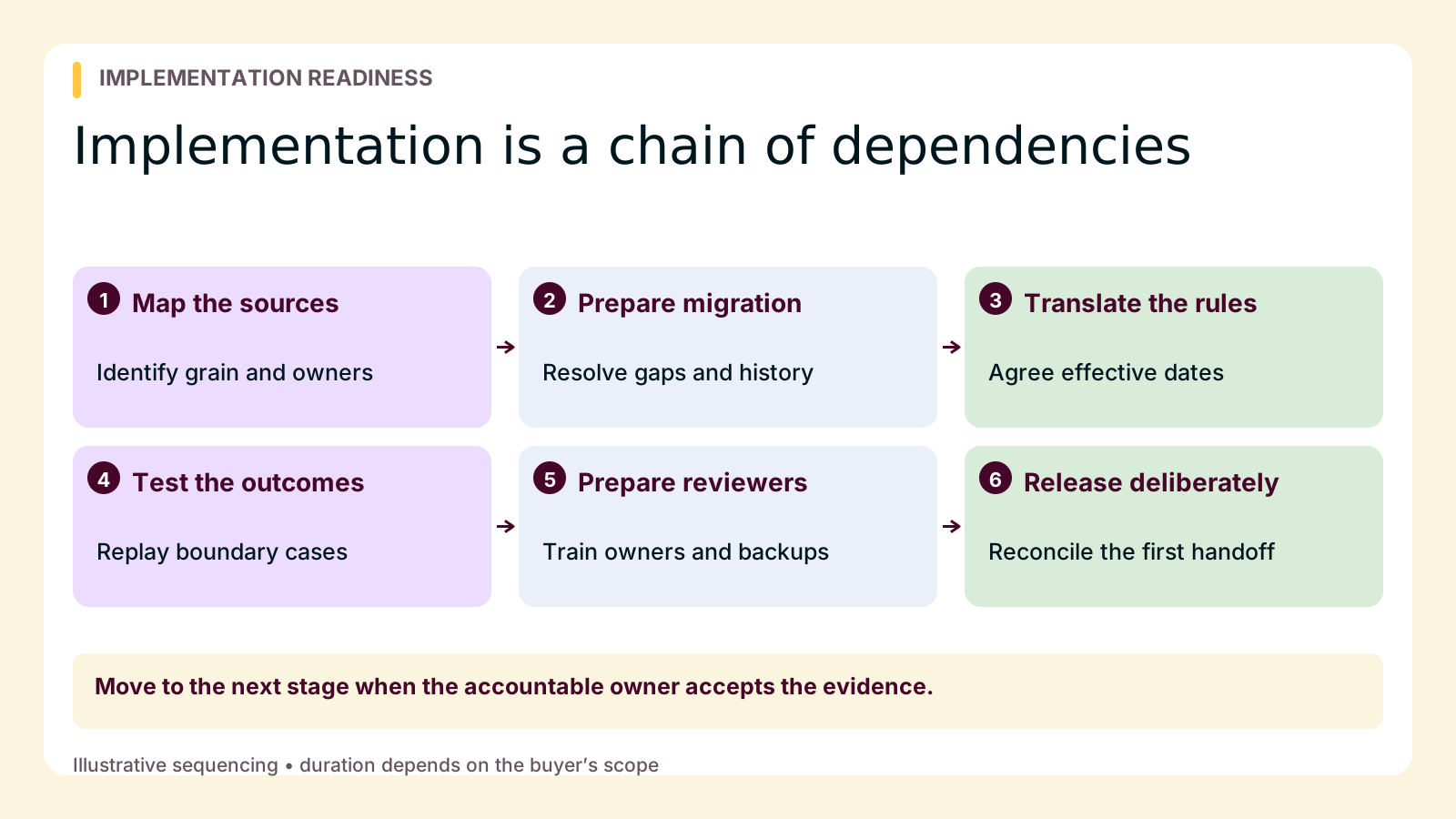
Migration moves selected history; remediation fixes missing, duplicated, or inconsistent information. Rule translation turns approved policy into executable logic. Test coverage establishes whether that logic behaves correctly, while adoption establishes whether people can operate and explain it. Keep these workstreams separate even when some run in parallel.
Use the matrix below in the implementation statement of work. Replace each role with a named owner and record the vendor’s corresponding deliverable.
| Workstream | Accountable owner | Dependency | Acceptance evidence | Unresolved question |
|---|---|---|---|---|
| Data inventory and access | IT/data lead | Systems and required fields identified | Approved mappings, permissions, and successful imports | Who monitors credentials and failed refreshes? |
| Data remediation | CRM/data owner | Stable worker and transaction identifiers | Resolved exception register and duplicate checks | Who corrects the source? |
| Rule translation | Compensation owner | Approved policies and effective dates | Signed expected-result examples | Which exceptions need a policy decision? |
| History and opening balances | RevOps lead | Clean extracts and approved migration scope | Reconciled counts, amounts, and balance classifications | Which prior periods must remain reproducible? |
| Historical parallel run | Finance reviewer | Configured rules and controlled inputs | Explained variances and successful retests | What blocks launch? |
| Pilot and adoption | Sales Operations lead | Validated statements and inquiry route | Users explain earnings and complete review tasks | Who supports the first close? |
| Payroll handoff | Payroll owner | Approved statements and destination requirements | Accepted test delivery and reconciled totals | How are rejects and duplicates handled? |
| Cutover and handover | Project sponsor | Accepted pilot and operational runbook | Signed go-live decision and fallback rehearsal | Who can stop the release? |
Inventory comes first. Remediation and policy clarification can then proceed together, but neither an unresolved balance nor an ambiguous rule should silently pass into validation. Start the pilot only after the historical run has met its acceptance criteria.
Establish data readiness before estimating configuration
Define what one imported row represents: a deal, invoice, or line item. Identify the system of record for bookings, employee eligibility, ownership, and plan policy. A deal joined to several invoices can multiply rows; a successful connection alone does not establish correct credit.
For Qobra, Salesforce and HubSpot inbound connectors are read-only. Both specify nightly full refreshes, incremental updates every two hours, and manual refresh. Schedule validation after the relevant refresh and record the last successful import. Do not assume a source edit appears instantly or that a correction in the commission environment changes the CRM.
Qobra’s Salesforce connector does not resolve polymorphic references such as WhoId and WhatId, which can point to different object types. If a rule depends on those relationships, agree on separate lookup fields or another workable design before approving the mapping.
Decide how much history needs active calculation versus retained reference access. Rebuilding every past plan is a different scope from importing approved opening balances and retaining historical statements. Require the proposal to distinguish them.
A concrete migration acceptance example
Consider a hypothetical migration with explicitly agreed expectations: 1,000 distinct paid historical commission records totaling $100,000, all in USD. The extract contains 1,010 rows because ten rows are duplicates. After duplicate removal, five distinct records totaling $500 lack valid worker identifiers.
The first import should therefore reconcile to 995 accepted records totaling $99,500, plus five quarantined records totaling $500. The ten duplicate rows belong in a separate rejection log; they are not ten additional commissions. Correct the worker mappings, rerun the affected records, and require the final result to equal 1,000 accepted records and $100,000, with no duplicate credits.
Assume a separate opening-balance file contains $12,000 of approved unpaid commissions across 20 payees, outside the $100,000 paid-history total. Reconcile those separately by payee and period; do not add them to paid historical amounts or automatically recalculate them as new earnings. Ask the vendor to demonstrate how the proposed configuration distinguishes paid history from amounts awaiting approval or handoff.
Every exception needs an owner, disposition, and retest result. Matching the grand total is insufficient if one worker’s overstatement offsets another’s understatement.
Approve rule meaning, then test the calculation
For a hypothetical tiered plan, assume eligible bookings earn 5% through $100,000 and 8% above that threshold. If the higher rate applies only to the excess, $110,000 generates $5,800: $5,000 plus $800. If crossing the threshold applies 8% to all eligible bookings, the result is $8,800.
Both formulas are executable; only the compensation owner can establish the intended policy. Approve expected outcomes before configuration, then test below, at, and above the threshold. Include split credit, ownership changes, refunds, missing records, and effective-date boundaries relevant to your plans. A calculated adjustment does not itself authorize a deduction.
Run a historical close with controlled inputs
Preserve the source extract, plan version, eligibility mapping, and approved adjustments used for the test. Compare results by record, worker, and period against independently approved expectations—not only legacy spreadsheet totals that may contain errors.
Classify each variance as a source-data issue, policy interpretation, configuration defect, or accepted legacy difference. Set rounding tolerances explicitly, but do not use a percentage tolerance to conceal missing workers or duplicate records. Resolve blocking variances and rerun affected cases before signing off.
Then test a future rule change. Have the intended administrator make it, explain the resulting difference, and route the statement through review. This tests maintainability, not merely whether a specialist can build the initial plan.
Interpret customer stories at the right scale
In Qobra’s published GoCardless story, Julija Slapaka reports roughly two hours to build a plan from scratch, test it, and activate it. That is useful evidence about one customer’s plan-building experience—not an end-to-end migration timetable. The story also reports a monthly commission process reduced from three or four days to at most one day, a separate operating outcome.
The ElevenLabs story describes a previous BigQuery-extract and spreadsheet workflow with sales-manager validation, followed by Salesforce synchronization and visibility into opportunities and rules for account executives and sales development representatives. RevOps reports fewer back-and-forth inquiries. Use Qobra’s customer implementation stories to frame questions about administrator ownership and user explanations, not to promise your own launch date.
Budget elapsed time, labor, and services separately
Request three estimates: calendar duration between milestones, customer labor hours by role, and vendor services with deliverables and exclusions. A project can wait for policy approval without consuming continuous configuration labor. Conversely, several teams can work simultaneously within a short calendar window.
Confirm whether the proposed scope covers historical imports, remediation assistance, test preparation, administrator training, cutover support, and first-close support. These are scope questions, not assumed package inclusions. Likewise, a shorter close cycle does not establish equivalent labor savings; released capacity is not automatically a cash reduction.
Make the pilot prove handoff and operating readiness
Select pilot users who represent ordinary plans and difficult exceptions. Require representatives to explain a statement and submit an inquiry, managers to review results, and a backup administrator to repeat a routine change using the runbook.
Test payroll delivery separately. Qobra provides webhook and API mechanisms for handing approved commission data to payroll; it does not execute payroll or move funds. Ask for evidence that the destination accepted the test delivery, reconciled worker identifiers and amounts, and handled rejected or repeated submissions appropriately.
Require a cutover and fallback evidence packet
Before signing go-live, request:
- The final source cutoff, last successful refresh, approved plan versions, and reconciled opening balances.
- A list of open issues, their owners, and explicit decisions on whether they block launch.
- A rehearsed fallback procedure identifying the last trusted calculation, who can pause handoff, and how duplicate delivery will be prevented.
- A handover runbook covering refresh monitoring, approvals, inquiries, credential ownership, escalation, and first-close support.
Ask the vendor to demonstrate the proposed recovery process; do not assume version control alone restores every data and delivery state. Obtain Finance, Operations, and payroll acceptance before the sponsor authorizes cutover. Choose the platform that leaves these responsibilities demonstrably manageable, and withhold the launch commitment until the acceptance packet is complete.